In this guide
- Use a short planning horizon Begin with the coming week rather than trying to solve every future possibility. Identify fixed events, recurring routines and tasks that depend on a callback or decision. Keep medical instructions in the appropriate care records; the household planning view should contain only the information each participant needs.
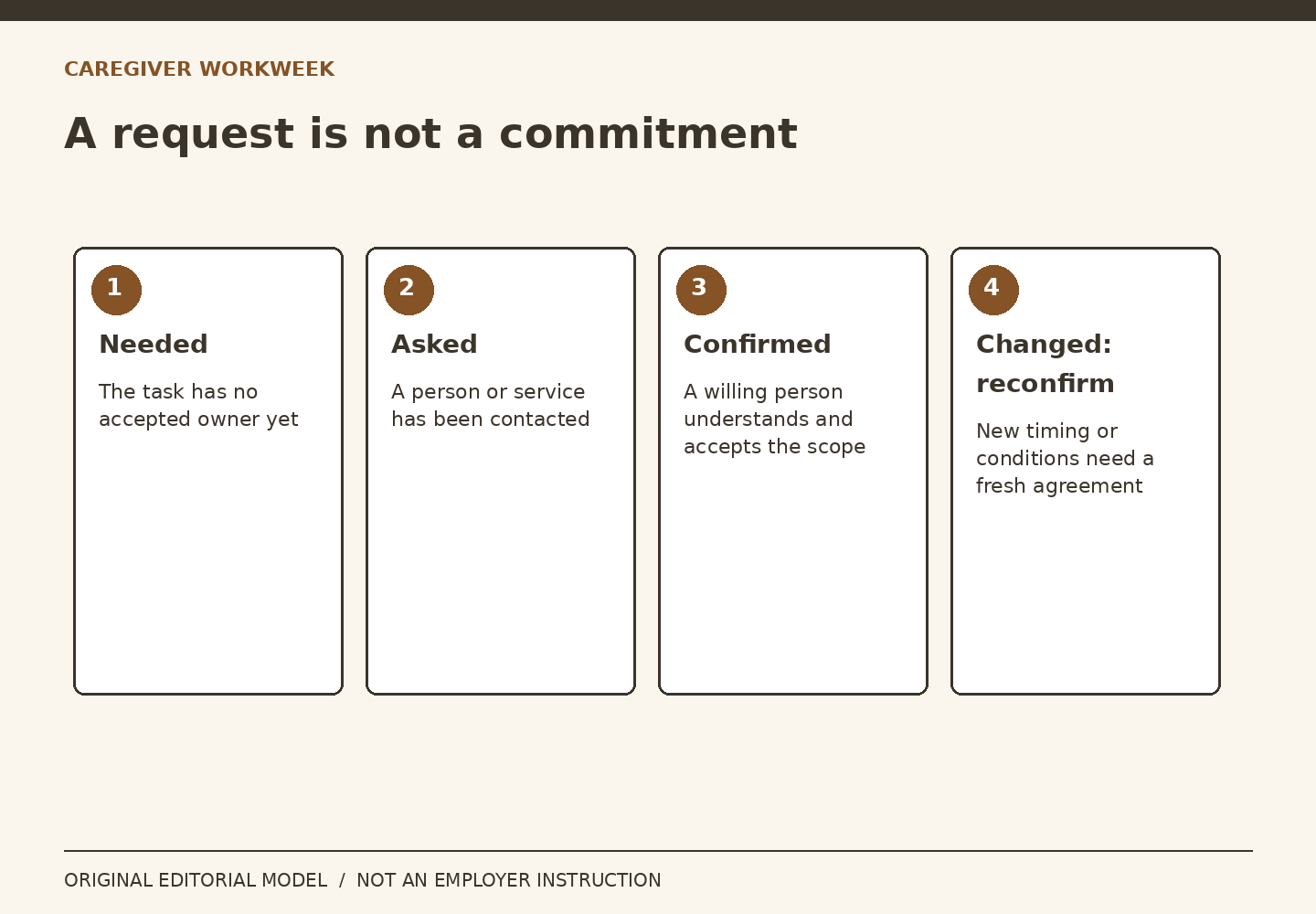
- Distinguish four states An original planning key can use “needed,” “asked,” “confirmed” and “changed.” These states prevent a request from masquerading as a commitment. A confirmed person should understand the task, time window and any relevant boundary. If the appointment moves, the old confirmation may no longer apply.
- Put the fallback beside the task A fallback should be a real contact or service that has been checked, not a hope that someone will be free. Ask when the fallback should be activated, who makes that contact and what happens if it is unavailable. For an immediate health or safety concern, use the appropriate emergency process; a weekly board is not an emergency plan.
- Reconcile the plan with work Identify where a care task overlaps with an assigned shift or expected availability. Follow the employer's process for schedule, leave or other arrangements. A family member agreeing to help does not create workplace approval, and a workplace approval does not confirm that home care is covered.
- Review the exceptions, not every detail A brief review can focus on what is unconfirmed, what changed and what needs a decision. Avoid a meeting that retells every medical event. Confirm the next contact and the next review point, then let people carry out the tasks they accepted.
- Sources and scope
A shared calendar can look complete while the actual care arrangement remains uncertain. A name in a box may mean “asked,” “probably available” or “confirmed.” For a Northwell worker coordinating adult-family care around shifts, those differences matter. The goal of a weekly plan is to expose uncertainty early enough for the right people to address it.
Use a short planning horizon Begin with the coming week rather than trying to solve every future possibility. Identify fixed events, recurring routines and tasks that depend on a callback or decision. Keep medical instructions in the appropriate care records; the household planning view should contain only the information each participant needs.
Ask the adult receiving support what belongs on the shared view and who should see it. A calendar invitation can disclose a clinic, condition or relationship to everyone included. Neutral descriptions and limited access may be appropriate, but do not assume that removing a diagnosis makes every detail non-sensitive.
Distinguish four states An original planning key can use “needed,” “asked,” “confirmed” and “changed.” These states prevent a request from masquerading as a commitment. A confirmed person should understand the task, time window and any relevant boundary. If the appointment moves, the old confirmation may no longer apply.
In a fictional example, a sibling agrees to drive to a morning appointment but has not agreed to wait or bring the adult home. The calendar entry “transport covered” hides the gap. Split the outward journey, waiting arrangement and return so the family can ask the right question. Do not infer that a transport provider supplies clinical supervision or assistance beyond its actual service.
Put the fallback beside the task A fallback should be a real contact or service that has been checked, not a hope that someone will be free. Ask when the fallback should be activated, who makes that contact and what happens if it is unavailable. For an immediate health or safety concern, use the appropriate emergency process; a weekly board is not an emergency plan.
The Administration for Community Living describes support funded through the National Family Caregiver Support Program. That is a starting point for asking about local services, not a guarantee of eligibility or a booking. Verify the provider, scope, cost and availability before relying on it.
Reconcile the plan with work Identify where a care task overlaps with an assigned shift or expected availability. Follow the employer's process for schedule, leave or other arrangements. A family member agreeing to help does not create workplace approval, and a workplace approval does not confirm that home care is covered.
Northwell's public Inclusion and Belonging page identifies a Caregiver BERG. A peer community may help you discover questions and resources, but it is not the authority for your schedule or a loved one's care plan. Keep those decisions with their actual owners.
Review the exceptions, not every detail A brief review can focus on what is unconfirmed, what changed and what needs a decision. Avoid a meeting that retells every medical event. Confirm the next contact and the next review point, then let people carry out the tasks they accepted.
If the plan repeatedly depends on one person's emergency availability, name that pattern. It may call for a different service arrangement or professional advice rather than a more elaborate spreadsheet. A good weekly plan reveals limits honestly and protects the adult's preferences while making practical help easier to coordinate.
Sources and scope
Public sources checked October 5, 2026. Dated accounts remain historical; examples and planning methods in this article are original editorial constructions.
- Northwell: Inclusion and Belonging
Current public description of the Caregiver and other BERGs; individual participation and support arrangements require verification.
- Administration for Community Living: National Family Caregiver Support Program
Public description of a state-supported caregiver program; local eligibility, services and availability are not determined here.