In this guide
- Begin with the person's priorities Ask the adult receiving support what they want help with and what they prefer to manage themselves. Do not turn a planning sheet into a declaration that someone has lost control of their life. A person may welcome a ride while wanting to speak to the clinician independently. They may want help comparing appointment times but not broad family access to records.
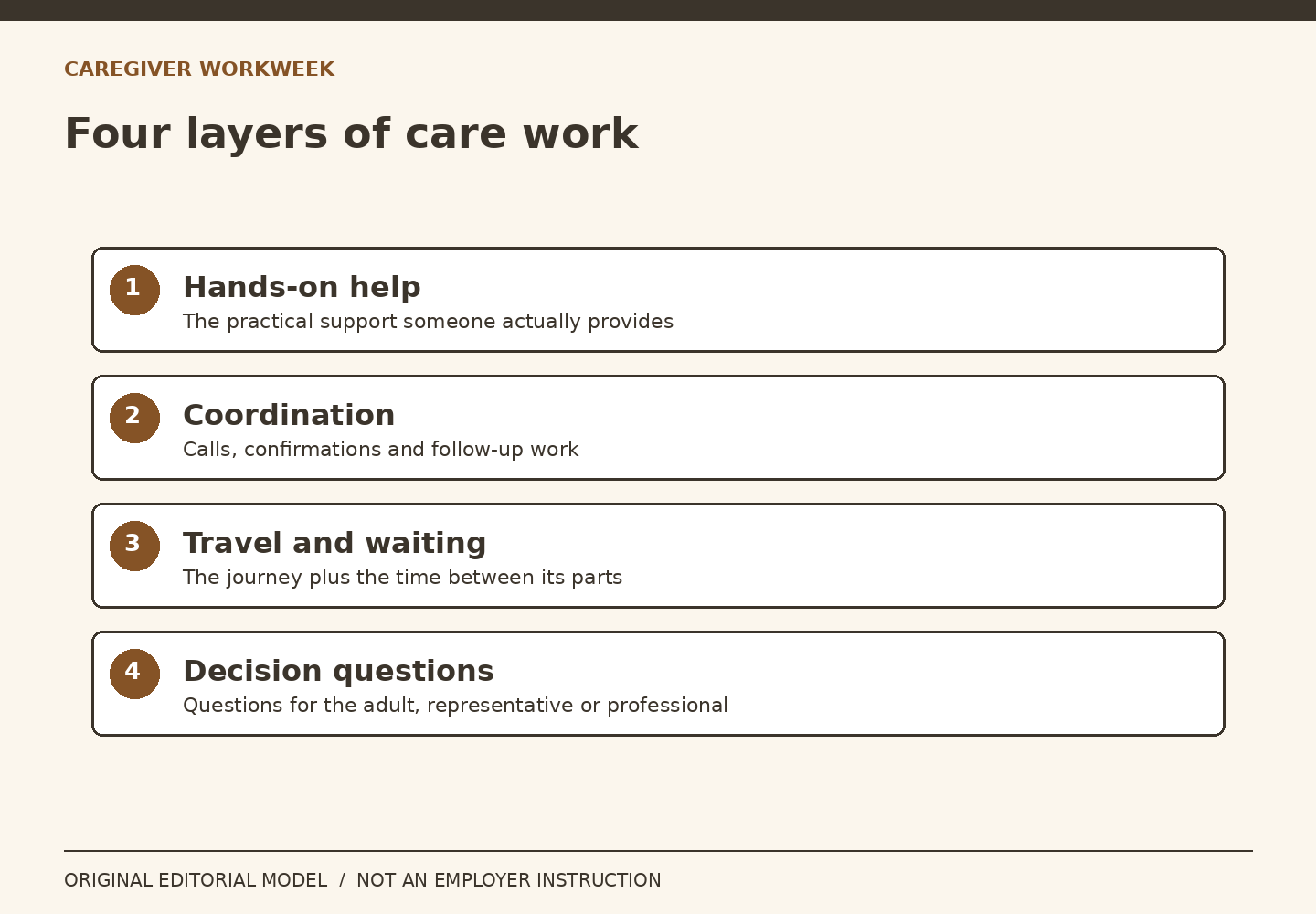
- Name four different kinds of work Hands-on support is the visible activity. Coordination includes calls, scheduling and confirming arrangements. Travel includes both the journey and the waiting or return. Decision work includes questions that require the adult, an authorized representative or a qualified professional. A task can involve several categories, but separating them reveals where help is actually needed.
- Describe a task so someone can accept it “Help more” is difficult to act on. “Can you confirm the return ride after the appointment time is known?” has a defined object. Include the time window, what confirmation is needed and whom to contact if the plan changes. Do not assign a task to someone who has not agreed or who lacks the necessary ability and authority.
- Keep the work conversation separate Once the tasks are visible, you can identify the actual conflict with work: a fixed appointment window, an uncertain return time or a recurring coordination duty. Take that specific scheduling or leave question to the employer's verified route. Do not assume a family plan changes your assigned hours, or that a manager's awareness settles benefit or legal questions.
- Sources and scope
Caregiving often enters a calendar as an appointment and occupies a much larger part of the week. Someone confirms the location, arranges a ride, checks what the care team asked the person to bring, waits for a callback and follows up afterward. A Northwell team member may do that work before or after a shift without ever calling it caregiving. Making the tasks visible can help the household ask for specific help.
Northwell's 2024 Family Caregivers Month article describes its caregiver community. That is useful organizational context, not a promise that a workplace resource can solve every home arrangement. This guide is an original planning exercise for adult-family support. It is not a clinical assessment, a legal decision or permission to change a work schedule.
Begin with the person's priorities Ask the adult receiving support what they want help with and what they prefer to manage themselves. Do not turn a planning sheet into a declaration that someone has lost control of their life. A person may welcome a ride while wanting to speak to the clinician independently. They may want help comparing appointment times but not broad family access to records.
If decision-making capacity, legal authority or immediate safety is in question, involve the appropriate professional rather than resolving it through a household checklist. The plan should reflect valid choices and responsibilities, not create them. Use the care team's guidance for clinical tasks and the relevant legal process for formal authority.
Name four different kinds of work Hands-on support is the visible activity. Coordination includes calls, scheduling and confirming arrangements. Travel includes both the journey and the waiting or return. Decision work includes questions that require the adult, an authorized representative or a qualified professional. A task can involve several categories, but separating them reveals where help is actually needed.
Consider a fictional adult's routine visit. One relative can provide transport, another can help prepare a question list with permission, and the adult can decide who accompanies them. The relative who drives does not automatically become the person authorized to receive every medical detail. Likewise, the family member who works in healthcare does not become the treating professional.
Describe a task so someone can accept it “Help more” is difficult to act on. “Can you confirm the return ride after the appointment time is known?” has a defined object. Include the time window, what confirmation is needed and whom to contact if the plan changes. Do not assign a task to someone who has not agreed or who lacks the necessary ability and authority.
The National Institute on Aging's caregiving orientation points readers toward needs, available helpers and community resources. Your household still has to establish its own workable arrangement. A list of possible resources is not proof that a service is available, appropriate or affordable for this person.
Keep the work conversation separate Once the tasks are visible, you can identify the actual conflict with work: a fixed appointment window, an uncertain return time or a recurring coordination duty. Take that specific scheduling or leave question to the employer's verified route. Do not assume a family plan changes your assigned hours, or that a manager's awareness settles benefit or legal questions.
The useful output is a clearer map, not a score of how devoted anyone is. Some tasks may remain unassigned, and some needs may require professional or community support. Treat those gaps as questions to resolve rather than evidence that one family member should absorb everything. The homepage gap checker helps identify coordination elements using fictional fixed choices; it does not assess whether a care arrangement is safe.
Sources and scope
Public sources checked October 5, 2026. Dated accounts remain historical; examples and planning methods in this article are original editorial constructions.
- Northwell: National Family Caregivers Month, 2024
Historical account of caregiver community and support; no private case, current staff title or guaranteed service is inferred.
- National Institute on Aging: Caregiving questions
General public caregiving orientation, not an assessment of an individual adult or care plan.