In this guide
- Choose work that can actually be done remotely The National Institute on Aging describes several forms of long-distance support, including coordination and research. The practical question is which task the adult wants help with and which permissions are needed. A phone call or online search is useful only if it connects to an agreed need.
- Give the local person a manageable interface Ask how and when a local helper prefers to exchange updates. Repeated calls during their own workday can add to the burden you hoped to reduce. Agree on the specific question and a reasonable update point rather than requesting a continuous stream of information.
- Define completion beyond sending a message A researched option is not a confirmed service. A call placed is not a response received. A booking request is not an accepted appointment. State the actual status so the local person does not rely on a task that is still open.
- Keep your own work boundary visible Northwell's public BERG page includes a caregiver community, but it does not give remote caregivers automatic flexibility during assigned work. Use the employer's process if a coordination duty conflicts with your availability.
- Sources and scope
Distance can make a caregiver feel either powerless or responsible for every detail. Neither is a useful starting point. A Northwell team member who lives far from an adult loved one can often contribute through a defined coordination task while respecting the person and the people present locally.
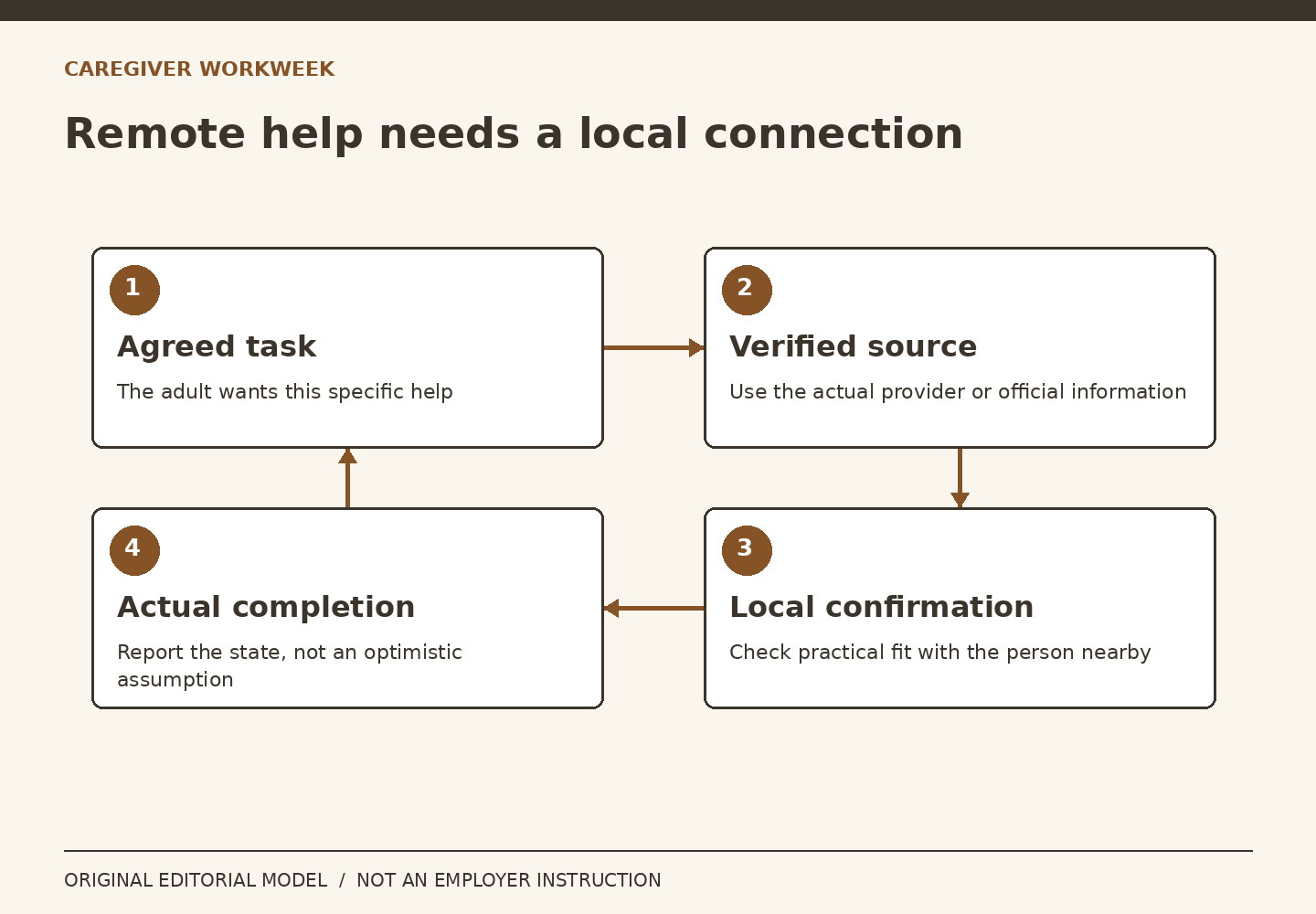
Choose work that can actually be done remotely The National Institute on Aging describes several forms of long-distance support, including coordination and research. The practical question is which task the adult wants help with and which permissions are needed. A phone call or online search is useful only if it connects to an agreed need.
For example, you might research public transport options for the person to consider, then ask a local helper to confirm the practical pickup arrangement. Do not book, share personal information or make financial commitments on someone else's behalf without the appropriate authority and agreement.
Give the local person a manageable interface Ask how and when a local helper prefers to exchange updates. Repeated calls during their own workday can add to the burden you hoped to reduce. Agree on the specific question and a reasonable update point rather than requesting a continuous stream of information.
Keep clinical questions with the care team. A remote relative should not interpret a photograph, symptom description or secondhand instruction as if it were a professional assessment. If there is an urgent concern, use the appropriate local emergency process rather than waiting for a family group chat.
Define completion beyond sending a message A researched option is not a confirmed service. A call placed is not a response received. A booking request is not an accepted appointment. State the actual status so the local person does not rely on a task that is still open.
In an original example, a remote relative finds two publicly listed services and sends their official contact pages. The task is “options found,” not “care arranged.” The next step belongs to the adult or authorized person who can verify fit and terms.
Keep your own work boundary visible Northwell's public BERG page includes a caregiver community, but it does not give remote caregivers automatic flexibility during assigned work. Use the employer's process if a coordination duty conflicts with your availability.
Remote help works best when it reduces a specific local burden and preserves the adult's choices. It does not require managing the household from afar or being reachable for every non-urgent question at all times.
Sources and scope
Public sources checked October 5, 2026. Dated accounts remain historical; examples and planning methods in this article are original editorial constructions.
- National Institute on Aging: Long-distance caregiving
General context for remote coordination; no care-provider recommendation or promise of access.
- National Institute on Aging: Helping from far away
Official 2025 infographic describes possible forms of support; the publication’s planning examples are original.
- Northwell: Inclusion and Belonging
Current public description of the Caregiver and other BERGs; individual participation and support arrangements require verification.